Validation of voyage emissions data and contractual arrangements for allocation of EU ETS costs remain key challenges for Greek shipowners as they face an estimated total €335m bill this year, potentially rising to €1bn once the regulation is fully implemented, according to OceanScore.
Some 2135 vessels owned or operated by around 400 Greek shipping companies are presently racking up liabilities under the EU Emissions Trading System (EU ETS) that will require them to surrender EU Allowances (EUAs) next year for GHG emissions incurred during 2024.
Maritime data analytics firm OceanScore, a global provider of solutions for regulatory compliance with offices in Hamburg, Poland, Portugal and soon Singapore, has calculated that Greek owners will be required to surrender 11.96m EUAs, based on 2022 voyage data for Greek-owned ships sailing both within and to/from the EU/EEA.
High average cost per vessel
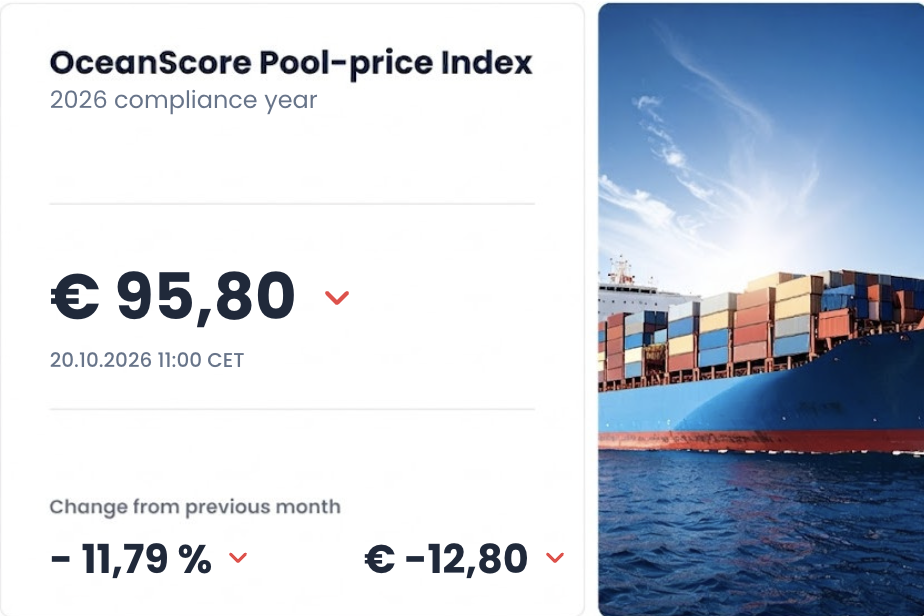
Given a current EUA price of around €70, this would result in total EUA costs of €335m for Greek shipping this year with 40% liability under the three-year phase-in of the EU ETS, increasing to €586m in 2025 with 70% exposure and €837m with full implementation in 2026 – though a moderate hop in the volatile EUA price could easily take this figure north of €1bn.
This would equate to an average emissions cost of nearly €400,000 per vessel once the EU ETS is fully implemented, though ships with green technology to curb emissions would clearly have much lower EUA exposure.
“Nonetheless, this will amount to significant additional liabilities related to emissions for many Greek shipping players that are active across most segments, predominantly the tanker and bulk trades, and will necessitate measures to mitigate their financial risk and limit exposure to the EU ETS,” says OceanScore’s co-Managing Director Ralf Garrn.
Typical emissions liabilities
More than 500 of the overall tally of Greek-owned vessels impacted by the EU ETS are in the hands of the 10 largest players, including Eastern Mediterranean, Minerva Marine, TMS Group and Thenamaris Ships Management.
An analysis carried out by OceanScore of the impact of the EU ETS on one typical Greek shipowner with 50 vessels shows that it would incur emissions liabilities of €18.5m from the requirement to purchase around 265,000 EUAs at full implementation based on the current EUA price.
OceanScore is seeing variable states of EU ETS readiness at Greek shipping companies, with a prevalent “wait-and-see” attitude, in common with much of the industry as it is still getting to grips with the complexities of the regulation, the impact on charter parties and the requirements for compliance, according to Garrn.
End-to-end solution
The company is now supporting the EU ETS compliance efforts of over 70 global clients, representing more than 1000 vessels, which have taken onboard its web-based digital tool ETS Manager that automates the various processes to provide a streamlined end-to-end solution for simplified management of EUA allocation and collection among stakeholders, with integrated EUA trading.
“It is therefore essential for Greek shipowners to finalise charter parties that incorporate EU ETS clauses to properly assign accountability for voyage EUA costs between themselves and the charterer so they can accurately determine their financial risk,” Garrn says.
“Commercial contracts need to be in place because, otherwise, the shipowner as the Document of Compliance holder can be left with having to bear the burden of EUA liabilities and possibly resorting to litigation against the charterer to recover emissions costs that are owed. But costs liability may be difficult to prove in a legal case long after the voyage has been completed.”
Need for data validation
This makes it important for shipping companies to have accurate real-time emissions data communicated from ship to shore for verification to support correct allocation of EUA costs among voyage stakeholders, also taking into account off-hires, Garrn says.
“It is good to see that a number of Greek shipowners are making strong progress in upgrading the quality of vessel data that needs to be fed via an API to the verification body,” he says.
Data validation with an accredited verifier is incorporated in ETS Manager, which provides efficient and transparent processes between owners, managers and charterers to manage EUAs and maintain control of EU ETS costs and related risks.
“Having an effective administrative system in place to track and allocate EUAs based on reliable operational data is essential to determine accountability with the EU ETS and thereby minimise financial risk,” Garrn says.
Proper data management will also be a vital prerequisite to tackle the upcoming FuelEU Maritime to be implemented from 2025, he adds, with OceanScore preparing to launch later this year its new digital solution FuelEU Planner to facilitate compliance with this complex regulation.
For more information contact:
Candice Buckle, Marketing Manager, OceanScore.
Email: candice.buckle@oceanscore.com