FuelEU Maritime Pooling: How Does It Work?
Understand how compliance surpluses and deficits can be combined, who can participate and what shipping companies need to consider before entering a pooling agreement.
Explore pooling prices now. Make a better-informed deal.
Waiting for your verified FuelEU compliance balance doesn't mean you have to wait to explore pooling opportunities.
Some surplus providers offer flexible-volume arrangements, allowing you to agree on a volume range at a fixed price before your final deficit is confirmed. The final quantity can then be determined within that range, subject to the agreed contractual terms.
By exploring your options early, you can better understand available surplus, compare pricing and prepare for the requirements of your chosen provider.

Good to know: You have time to decide, but preparing early pays off.
FuelEU pooling arrangements for the 2026 compliance year don't need to be finalised before year-end. The deadline for finalising pool composition and allocation is 30 April 2027, although individual surplus providers may set earlier deadlines.
Exploring your options now gives you more time to compare offers, understand the terms and identify suitable opportunities before making a commitment.
Five checks for a smoother FuelEU pooling decision
From estimating your deficit to reviewing contractual terms, these five practical checks can help you prepare for pooling with greater clarity and confidence.
Plan your volume, including uncertainty
You don't need a final deficit to start exploring your options.
- What is your estimated compliance deficit?
- How much could that figure change before verification?
- Does the provider offer a flexible volume range at an agreed price?
- When and how must the final quantity be confirmed?


How OceanScore Helps
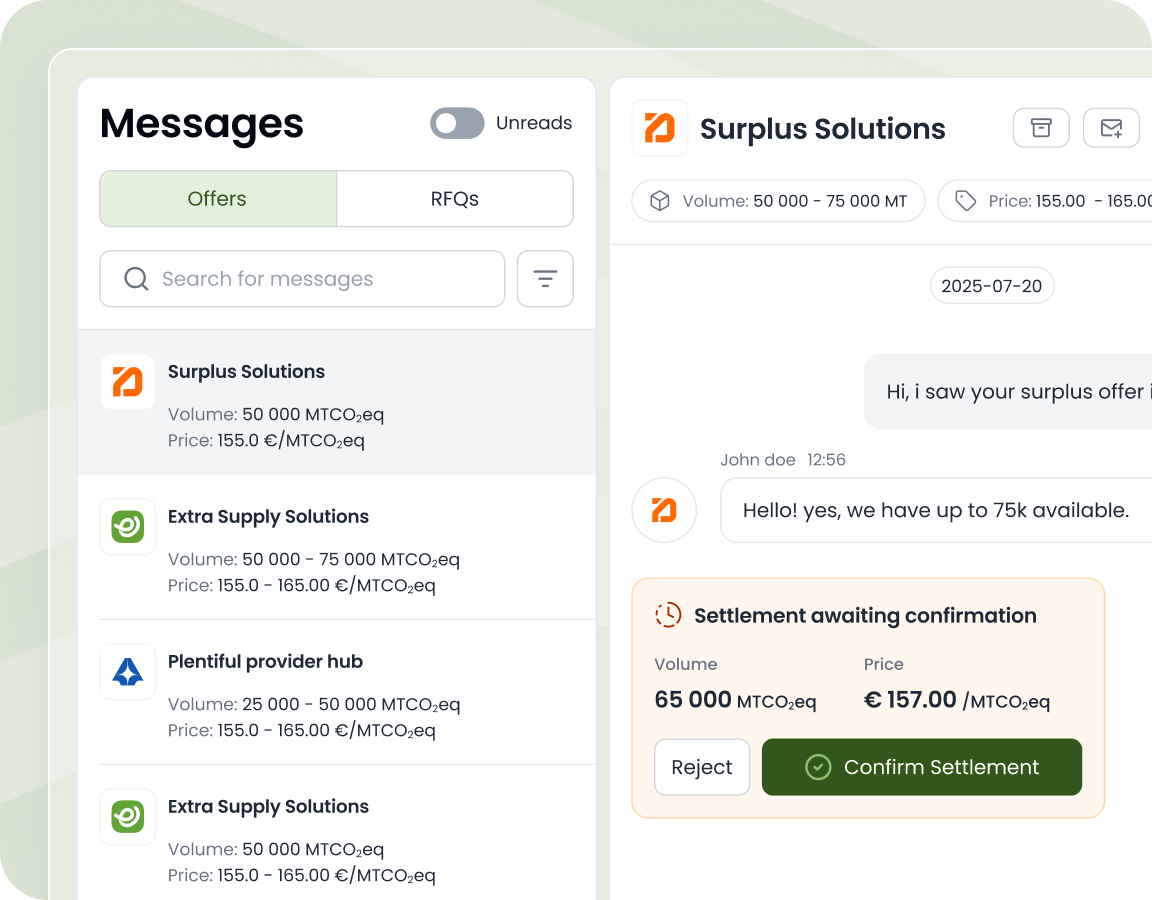
OceanScore's Pooling Marketplace lets you explore surplus offers from multiple providers, including flexible-volume arrangements where available. You can compare options and discuss volume requirements directly with potential counterparties before committing to an agreement.
Your estimated FuelEU compliance balance may change before verification. Consider whether a flexible-volume arrangement could help you secure suitable terms while accommodating that uncertainty.
Understand your surplus source
A competitive price is important. Knowing who you're dealing with matters just as much.
- Is the surplus provider a trusted entity with a reliable track record?
- Is your contractual counterparty clearly identified, with responsibilities and obligations defined?
- How much is enough? What is the required minimum?
- Are the terms and responsibilities clearly defined?
How OceanScore Helps
The Pooling Marketplace provides access to offers from multiple surplus providers, with information to help you assess available options. You can also communicate directly with counterparties to clarify details before proceeding.
Working with a trusted surplus provider reduces the risk of failed delivery, unexpected costs and potential FuelEU penalties. Transparency around the source and counterparty helps you assess these risks and make a more informed decision beyond price alone.
Compare offers with confidence
Is the price you're being offered competitive?
- How does the offered price compare with current market levels?
- What do recent pricing trends indicate?
- Are you comparing offers with similar volumes and contractual conditions?
- Have you compared quotations from multiple independent surplus providers?
How OceanScore Helps
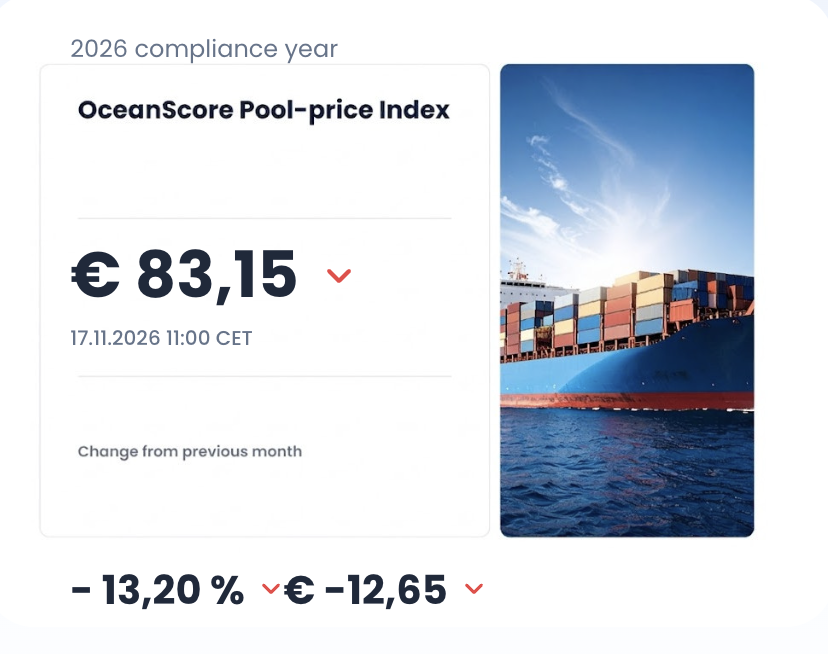
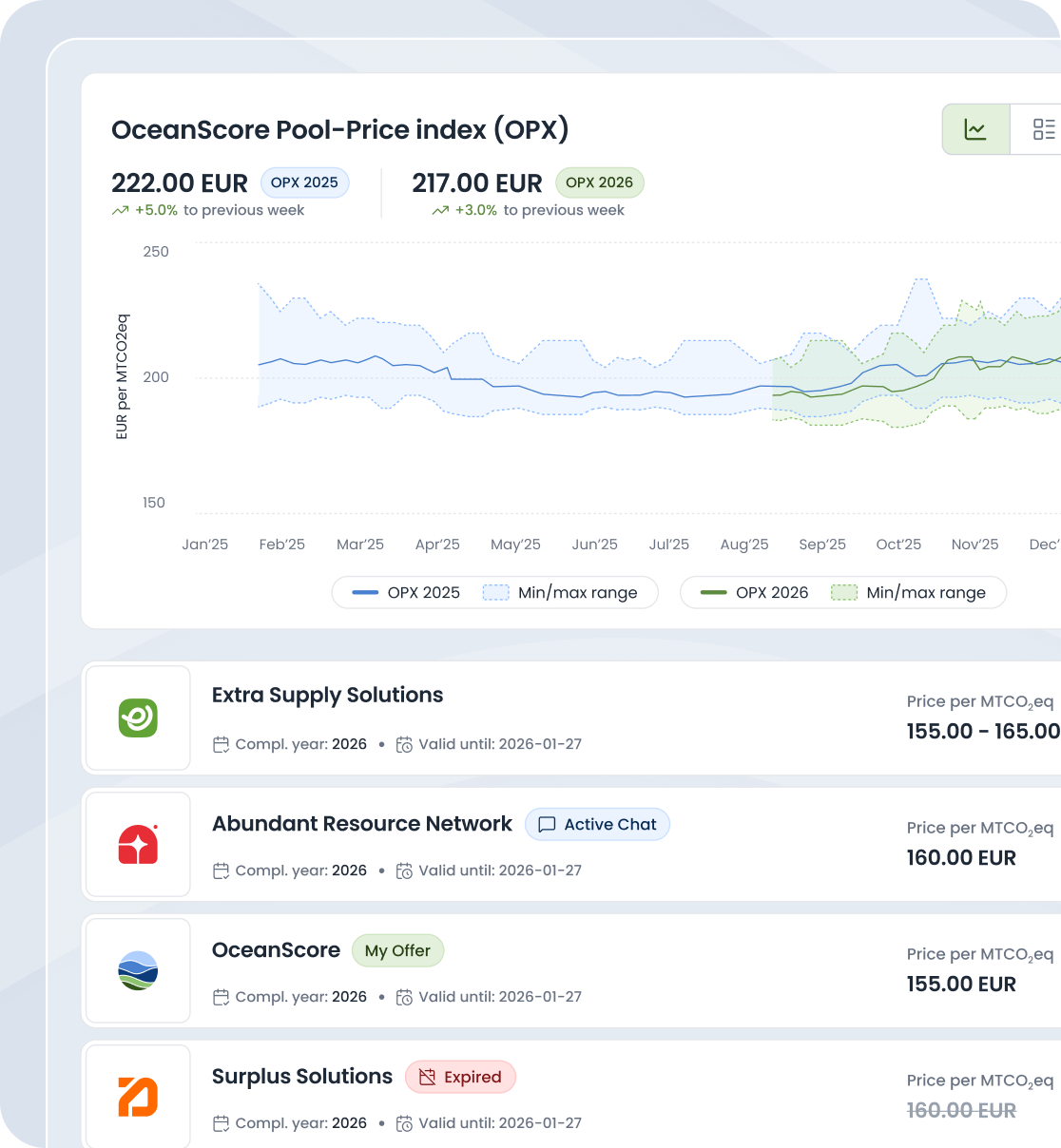
The OceanScore Pool-Price Index (OPX) provides market pricing insights to support offer comparisons and commercial decisions. Through the Marketplace, you can review listed offers and submit Requests for Quotations (RFQs) with flexible visibility options. For example, you can discreetly request surplus without making your requirements visible to the entire Marketplace. This gives you greater control over how you approach potential providers and compare quotations.
FuelEU pooling prices can fluctuate as supply, demand and market conditions change. Understanding the broader market helps you assess whether an offer meets your commercial needs. When comparing offers, make sure you're comparing like for like. Differences in volume, delivery obligations, contractual protections and other conditions can make two offers with similar prices very different in practice. Use market benchmarks such as OPX to put prices into context.
Know what you're agreeing to
The lowest price isn't necessarily the best agreement.
- What happens if the agreed surplus is not delivered?
- Does the contract address repayment and compensation for resulting penalties?
- Are responsibilities and deadlines clearly defined?
- Do your charter-party terms adequately address FuelEU cost reimbursement?
How OceanScore Helps
The Marketplace supports direct communication with counterparties and access to contractual information made available by sellers. OPX can also serve as a market-based reference when negotiating FuelEU reimbursement arrangements between owners and charterers. OceanScore's team is available to provide practical guidance throughout the process.
Before committing to a pooling arrangement, check what happens if the agreed surplus is not delivered. A well-structured agreement should clearly define the provider's delivery obligations and the remedies available in case of non-delivery, such as replacement surplus or compensation for agreed additional costs. Make sure responsibilities, deadlines and potential liabilities are clearly defined. In particular, check whether the agreement addresses compensation if non-delivery results in additional compliance costs or a FuelEU penalty. For vessels operating under charter arrangements, clearly defined FuelEU reimbursement terms help avoid disputes between owners and charterers. Agreeing on a market-based reference such as OPX can help ensure reimbursements reflect actual pooling costs rather than automatically relying on fixed penalty rates.
Prepare for KYC requirements
Avoid unnecessary delays by preparing your documentation early.
- Which documents does your chosen provider require?
- Are there specific formats or verification requirements?
- Who within your organisation needs to provide or approve the information?
- What deadlines apply to the provider's onboarding process?
How OceanScore Helps
OceanScore's team can provide personal guidance to help you anticipate your chosen provider's requirements and prepare for the next steps.
Once you've selected a surplus provider, you may need to complete Know Your Customer (KYC) checks before finalising an agreement. Requirements can differ between providers, so understanding what's needed in advance can help keep the process moving.
Ready to put the checks
into practice?
Explore available surplus offers and request quotations. No transaction fees for surplus seekers.

Ready to turn your options into a deal?
More surplus choices. Less quotation chasing.
A clearer way forward.
Finding the right FuelEU pooling agreement shouldn't mean contacting providers one by one, comparing disconnected quotations and trying to make sense of different commercial terms.
The OceanScore FuelEU Pooling Marketplace connects you with a broad network of surplus providers, making it easier to find and compare competitive offers.
Explore surplus from multiple providers, evaluate prices and contractual conditions, and connect with potential counterparties to move towards an agreement that suits your needs.
Available as a standalone module, without requiring Compliance Manager. Access is included at no additional charge for Compliance Manager users.
What you can do in the Marketplace

Explore surplus from multiple providers
Access a broad selection of surplus sellers and explore different volumes, sources and commercial conditions without exclusivity requirements.

Find offers that fit your needs
Review listed offers or request quotations with control over who sees your enquiry. You can also discreetly request surplus without making your requirements visible to everyone.

Understand what a competitive price looks like
Use OceanScore's Pool-Price Index (OPX) alongside available offers to put pricing into context.

Connect directly with counterparties
Use direct chat communication to clarify requirements, discuss terms and explore potential pooling agreements.

No transaction fees for surplus seekers
OceanScore does not charge surplus seekers transaction fees for pooling agreements arranged through the Marketplace.

Get help when you need it
Our pooling team provides personal guidance, while our AI assistant answers your regulatory and tool-specific questions in multiple languages.
For existing Compliance Manager customers, Marketplace access is included at no additional charge.
Standalone Marketplace access and optional managed services have separate commercial terms.
Take the five checks into your next pooling conversation.
Keep the most important considerations at hand with our practical one-page checklist, covering volume planning, surplus sources, pricing, contracts and KYC preparation.

Useful resources, whenever you need them.
Whether you're exploring pooling for the first time or already evaluating agreements, we've gathered a few resources to make the process easier.
Discover the FuelEU Pooling Marketplace
See how the platform helps deficit holders find surplus providers, explore offers and move towards suitable pooling agreements.
Download the flyerFind answers to common FuelEU pooling questions
Explore our article covering how FuelEU pooling works, surplus availability, pricing and practical considerations when preparing an agreement.
Read the article & FAQsUnderstand FuelEU pooling prices
Discover how OceanScore's Pool-Price Index (OPX) provides market pricing insights to support commercial decisions.
Explore OPXPrefer to have someone by your side? The right support, whenever you need it.
Every fleet is different. So is every pooling decision.
Maybe you're unsure which volume arrangement suits your situation. Perhaps you have a question about a supplier's requirements or want to understand the commercial implications of a particular offer.
Whatever the question, you don't have to work through it alone.
OceanScore's pooling team is here to help you understand your options and decide on the next step.



OceanScore pooling team
Pooling Management Service
OceanScore also offers a Pooling Management Service for companies looking for additional support. From sourcing suitable surplus to coordinating pooling arrangements, our team can help manage the process on your behalf.