FuelEU Maritime pooling allows shipping companies to combine the compliance balances of multiple vessels to meet the regulation’s greenhouse gas intensity requirements. Ships generating a compliance surplus can help offset the deficits of other vessels, enabling companies to achieve compliance without every ship having to meet the target individually.
For the company responsible for the ship, pooling offers a more cost-efficient alternative to paying FuelEU penalties. Charter party terms determine how that cost is shared with charterers. However, securing the right surplus, understanding market prices and managing contractual arrangements are essential to making pooling work commercially.
This article explains how FuelEU Maritime pooling works, who can participate, how surplus is transferred, what pooling costs and what shipping companies should consider before entering an agreement.
FuelEU Maritime Pooling: Key Facts
Optional compliance mechanism
Pooling is one way to meet FuelEU requirements.
Cross-company pooling
Vessels from different companies can participate.
Flexible preparation
You can explore options before your final deficit is verified.
Market-based pricing
Surplus prices are commercially negotiated.
Potential cost savings
Pooling can cost significantly less than paying penalties.
2027 finalisation
Pool composition for 2026 must be finalised by 30 April 2027.
What is FuelEU Maritime pooling?
FuelEU Maritime is a European Union regulation designed to reduce the greenhouse gas intensity of energy used by ships above 5,000 gross tonnage. The scope covers 100% of the energy used at berth in an EU port and on voyages between two EU ports, and 50% of the energy on voyages to or from a non-EU port or an EU outermost region.
The regulation applies from 1 January 2025 and introduces progressively stricter greenhouse gas intensity reduction targets.
For the initial compliance period from 2025 to 2029, the required reduction is 2% compared with the regulatory reference value. This increases to 6% in 2030, 14.5% in 2035 and 31% in 2040, with further steps in later years.
Ships that perform better than the required target generate a positive compliance balance, commonly referred to as a FuelEU surplus. Ships that fall short generate a negative compliance balance, or FuelEU deficit.
Pooling allows these positive and negative balances to be combined, provided the applicable regulatory requirements are met. This creates an opportunity for vessels generating surplus to support vessels facing deficits, potentially reducing overall compliance costs.
How does FuelEU Maritime pooling work?
FuelEU Pooling: Five Steps
From understanding your compliance balance to finalising your pool.
Understand your expected FuelEU surplus or deficit.
Identify reliable counterparties and available volumes.
Evaluate pricing, market benchmarks and contractual conditions.
Clarify responsibilities, payment arrangements and protections.
Complete allocation and verification within the applicable deadlines.
The pooling process involves identifying compliance deficits, sourcing sufficient surplus, agreeing on commercial terms and allocating the combined compliance balance across participating vessels. In practice, shipping companies typically follow five steps:
Step 1: Calculate your FuelEU compliance balance
The first step is understanding whether your vessel is expected to generate a surplus or deficit.
A vessel’s compliance balance depends on its energy consumption, the greenhouse gas intensity of the energy used and the applicable FuelEU requirements. Vessels using lower-emission fuels may generate surplus, while vessels relying on conventional fossil fuels are more likely to face deficits.
OceanScore’s Compliance Manager helps shipping companies calculate, monitor and forecast their FuelEU compliance balances across their fleets. By providing visibility into expected surpluses and deficits, it supports early compliance planning and more informed pooling decisions.
Importantly, shipping companies do not necessarily need to wait for their final verified compliance balance before exploring pooling opportunities. Some surplus providers offer flexible-volume arrangements that allow buyers to agree on a volume range at a fixed price, with the final quantity determined later according to the agreed terms.
↓
Step 2: Find a suitable surplus provider
Once a company understands its expected deficit, it can explore opportunities to obtain surplus from other vessels. Surplus may be available from vessels within the same fleet or from external providers.
For companies seeking external surplus, the challenge is identifying suitable counterparties and understanding what is available. A competitive pooling market gives deficit holders access to multiple potential providers rather than relying on a single source. When evaluating surplus offers, shipping companies should consider:
- The identity and reliability of the surplus provider.
- The origin and availability of the surplus.
- The volume offered.
- The proposed price.
- The contractual conditions and delivery obligations.
Access to multiple offers helps companies compare their options and identify arrangements suited to their compliance requirements.
↓
Step 3: Compare pooling prices and commercial terms
FuelEU pooling prices are determined commercially between the parties involved. There is no single fixed market price for surplus. Prices can change depending on supply, demand, the compliance year, available volumes and contractual conditions.
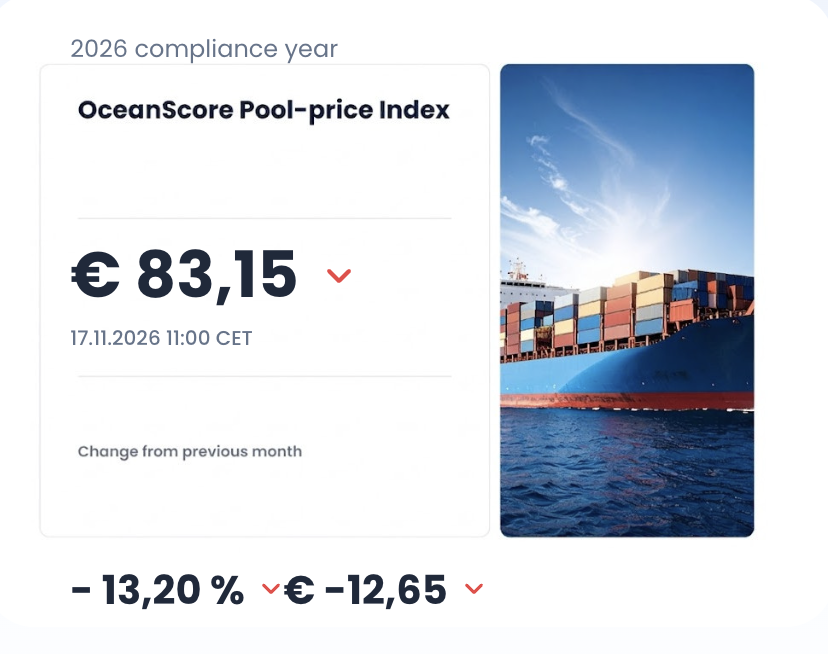
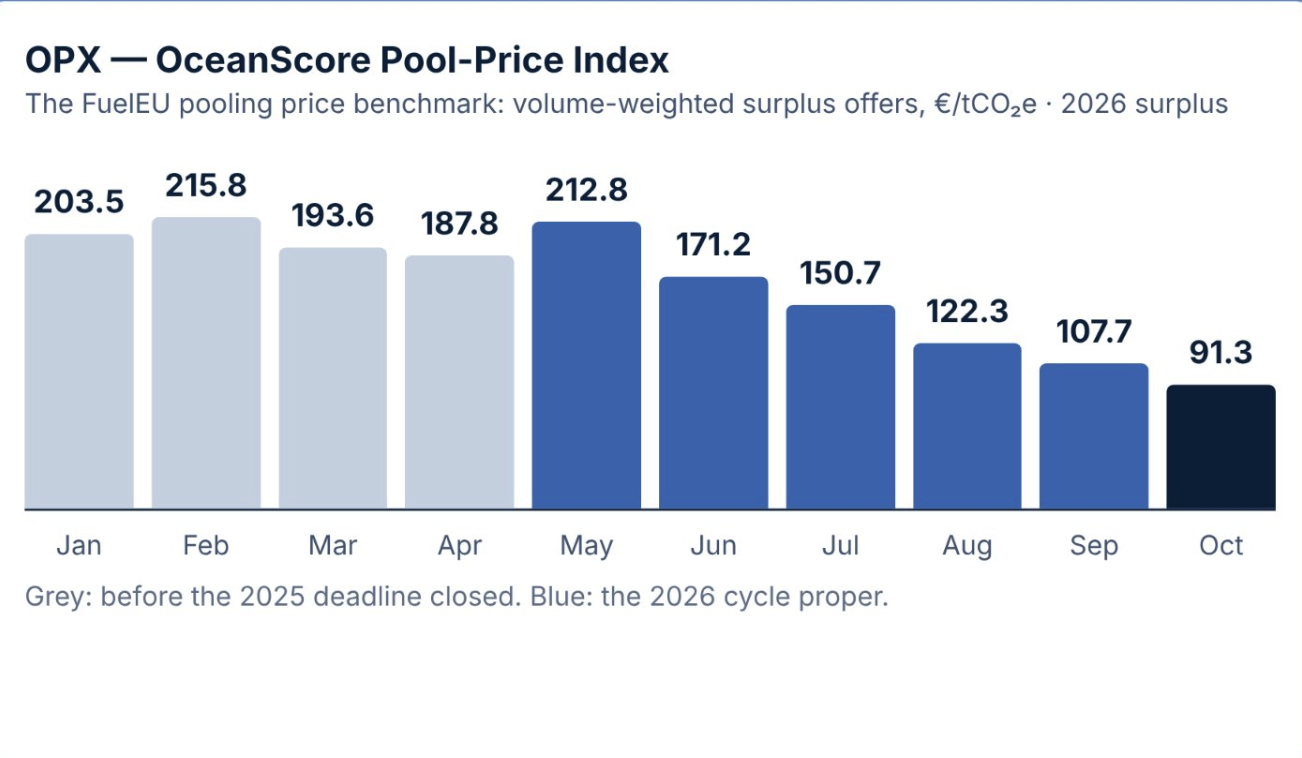
This makes price transparency particularly important. For example, OceanScore’s Pool-Price Index (OPX) tracks market pricing developments and provides a benchmark for evaluating pooling offers.
In October 2026, the OPX stood at €95.80 per tonne of CO₂ equivalent, down from €108.60 in September. Offer levels ranged from €70 to €138 per tonne in October, compared with €102 to €160 in September.
One of the clearest drivers behind this movement is the rapid increase in competition among surplus sellers. Where the market counted around 5 to 10 sellers last year, more than 40 are now competing for buyer demand, and individual sellers can bring volumes to market comparable in size to the entire Greek fleet’s compliance deficit. With available surplus continuing to outweigh demand, sellers are competing increasingly aggressively to secure commercially relevant volumes.
While these historical figures do not predict future prices, they demonstrate why shipping companies benefit from monitoring the market and comparing offers before making commercial commitments.
↓
Step 4: Agree on the pooling arrangement
Once a suitable provider has been identified, the parties must agree on the commercial and contractual terms. These may include the volume of surplus, price, payment arrangements, deadlines and responsibilities.
Particular attention should be paid to what happens if the agreed surplus is not delivered. For example, buyers should consider whether the contract provides for repayment and compensation for any resulting FuelEU penalty if the supplier fails to fulfil its obligations.
For vessels operating under charter agreements, another important consideration is how FuelEU compliance costs are allocated between the company responsible for the ship and the charterer under the charter party. Market benchmarks such as OPX can support these negotiations by providing an agreed reference for FuelEU reimbursement arrangements.
↓
Step 5: Finalise and verify the pool
Once the commercial arrangements are agreed, the participating vessels must be included in a pool that meets FuelEU Maritime’s regulatory requirements.
The pool’s total compliance balance must be non-negative, and the allocation of compliance balances between vessels must follow the applicable rules. The allocation must also be verified through the relevant FuelEU compliance process.
For the 2026 compliance year, two important dates are:
- 31 January 2027: FuelEU reporting deadline for the 2026 reporting period.
- 30 April 2027: Deadline for finalising pool composition and compliance balance allocation.
Individual surplus providers may establish earlier commercial deadlines, so companies should confirm the relevant timetable with their chosen counterparty.

Is FuelEU Maritime pooling cheaper than paying penalties?
Pooling can be significantly more cost-efficient than paying FuelEU penalties, depending on market prices and the terms of the agreement.
Under FuelEU Maritime, the penalty for a compliance deficit is fixed at €2,400 per tonne of VLSFO-equivalent shortfall, increasing by 10% for each additional consecutive year of deficit. Pooling provides an alternative by allowing deficits to be offset using surplus generated by other vessels.
The commercial benefit depends on the price paid for surplus compared with the potential penalty exposure.
However, the lowest available pooling price does not automatically represent the best agreement. Shipping companies should also consider counterparty reliability, contractual protection, surplus availability and the timing of their compliance decisions.
The objective is not simply to find the cheapest surplus, but to secure a commercially attractive arrangement that delivers the required compliance outcome.
Can vessels from different shipping companies join the same FuelEU pool?
Yes. FuelEU Maritime allows vessels from different companies to participate in the same compliance pool, provided the applicable regulatory conditions are satisfied.
This is particularly important because it enables companies with compliance deficits to access surplus generated outside their own fleets. For example, a company operating conventional-fuel vessels may obtain surplus from a provider operating vessels using lower-emission fuels.
The companies can agree on commercial compensation for the surplus allocated through the pool.
This creates a market in which surplus providers can monetise positive compliance balances while deficit holders can potentially reduce their compliance costs.
Can shipping companies arrange pooling before their final deficit is known?
Yes. Companies can begin exploring and negotiating pooling arrangements before their final verified compliance balances are available.
However, the final pool allocation must be based on the applicable verified compliance balances.
Some surplus providers offer arrangements that accommodate this uncertainty through flexible-volume agreements. For example, a buyer may agree on a minimum and maximum volume at a fixed price, with the final quantity confirmed later within the agreed range. The exact flexibility depends on the provider and the contractual terms.
Preparing early can help companies understand available options, compare pricing and avoid unnecessary delays closer to the compliance deadlines.
What should shipping companies check before entering a FuelEU pooling agreement?
Before committing to a pooling arrangement, shipping companies should review five essential considerations.
- Expected compliance volume
Estimate the deficit and assess how much it could change before verification. Consider whether flexible-volume arrangements would be appropriate.
- Surplus source and counterparty
Understand who provides the surplus, where it originates and which entity will be responsible for fulfilling the agreement.
- Pricing and market benchmarks
Compare available offers and use market intelligence to assess whether the proposed price is competitive.
- Contractual protection
Review the obligations of both parties, particularly the provisions addressing non-delivery, repayment and potential penalties.
- KYC and onboarding requirements
Clarify which documents and approvals your chosen surplus provider requires and when they must be submitted.
These checks help companies evaluate pooling opportunities beyond price alone and prepare for a smoother compliance process.
How can shipping companies find competitive FuelEU pooling offers?
Finding a suitable pooling arrangement requires access to available surplus, reliable counterparties and transparent market information.
Traditionally, companies may need to contact several brokers or providers individually to obtain quotations and compare offers. A digital pooling marketplace simplifies this process by bringing multiple providers and opportunities together.
The OceanScore FuelEU Pooling Marketplace connects deficit holders with surplus providers through a single platform. Shipping companies can use it to:
- Explore surplus offers from multiple providers.
- Compare prices using OPX market intelligence.
- Submit Requests for Quotations (RFQs) with different visibility options.
- Communicate directly with counterparties.
- Review available commercial information.
- Access expert guidance when needed.
The Marketplace does not require companies to use OceanScore’s Compliance Manager and is also available as a standalone module. The FuelEU Pooling Marketplace does not charge transaction fees.
Companies that prefer additional assistance can also use OceanScore’s Pooling Management Service, which provides a more comprehensive approach to sourcing and managing pooling arrangements.
What happens to FuelEU Maritime pooling after 2026?
FuelEU Maritime’s greenhouse gas intensity requirements become progressively stricter over time. The required reduction increases from 2% during 2025–2029 to 6% in 2030.
This is expected to influence the balance between compliance deficits and available surplus. Under a scenario where fleet composition and fuel use remain unchanged, the market-wide compliance deficit could increase substantially when the stricter 2030 requirements take effect.
At the same time, the cost of generating surplus may change as fuel markets and alternative fuel availability evolve.
These developments make longer-term compliance planning increasingly important. For the companies responsible for ships and the charterers they contract with, understanding future exposure, monitoring market developments and considering contractual arrangements early can help support more informed commercial decisions.
Expert commentary by Orestis Nikolopoulos, Head of Eastern Mediterranean at OceanScore
Expert PerspectiveOrestis Nikolopoulos
Head of Eastern Mediterranean, OceanScore
“Pooling costs are a fraction of the FuelEU penalty,
and that gap is the entire commercial case for pooling.”
But that advantage should not stop at the compliance department.
Time charters cover roughly 70% of the fleet, and whenever a charterer
reimburses an owner against a fixed penalty figure instead of a market
reference, one side ends up carrying a cost the other side no longer has,
so FuelEU exposure belongs in the charter party too, backed by an
index-linked clause benchmarked against a transparent reference such as OPX.Right now, the cost of generating surplus is rising while pooling prices
have fallen sharply, a gap wide enough that some sellers are already
pricing close to, or below, their own cost. That will not last.Companies planning their 2027 pooling strategy should treat today’s
prices as a window to act on, not a baseline to plan around.

Frequently Asked Questions About FuelEU Maritime Pooling
Is FuelEU pooling mandatory?
No. Pooling is one of the compliance flexibility mechanisms available
under FuelEU Maritime. Companies can also meet the requirements through
their vessels’ own performance or other permitted compliance mechanisms.
Can a vessel with a FuelEU deficit join a pool?
Yes. A vessel with a negative compliance balance can participate in a pool,
provided the pool meets the applicable regulatory requirements and the
vessel’s allocated balance satisfies the relevant conditions.
Can surplus be purchased from another company?
Companies can enter commercial arrangements to obtain surplus generated
by vessels operated by other companies. The surplus is allocated through
the regulated pooling mechanism rather than transferred as a standalone
certificate.
Is there a fixed price for FuelEU surplus?
No. FuelEU surplus prices are commercially negotiated and may vary
according to market conditions, volumes and contractual terms.
Does FuelEU pooling need to be completed before the end of 2026?
No. Pooling arrangements for the 2026 compliance year are finalised
during the 2027 compliance process. However, surplus providers may
impose earlier commercial deadlines.
What is the OceanScore Pool-Price Index?
The OceanScore Pool-Price Index (OPX) provides market-based pricing
information for FuelEU surplus. It helps shipping companies understand
price developments, benchmark offers and support commercial negotiations.
What is the difference between FuelEU pooling and the Pooling Marketplace?
FuelEU pooling is the regulatory mechanism that allows vessels to combine
compliance balances. The OceanScore FuelEU Pooling Marketplace is a
commercial platform that helps deficit holders find surplus providers,
compare offers and arrange pooling opportunities.
Make your next FuelEU pooling decision with confidence
FuelEU Maritime pooling offers shipping companies a practical way to manage compliance deficits while potentially reducing costs. However, successful pooling requires more than identifying available surplus. Understanding market conditions, comparing providers and reviewing contractual terms are essential to making informed decisions.
With access to multiple surplus providers, transparent market intelligence and practical support, OceanScore helps shipping companies navigate FuelEU pooling with greater confidence.
Explore the OceanScore FuelEU Pooling Marketplace to compare available opportunities and prepare for your next compliance decision.