carbon marketcarbon priceEmissionseu carbonEU ETSEuropean Commissionshipping companiesverified emissions
3 min read

Clearly defining responsibility

Shipping companies need to establish clear lines of responsibility both for reporting emissions under the EU’s MRV (Monitoring, Reporting and…

OceanScore
OceanScore’s review of BIMCO’s FuelEU Maritime clause and its challenges.

Shipping companies need to establish clear lines of responsibility both for reporting emissions under the EU’s MRV (Monitoring, Reporting and Verification) regime and surrendering EU Allowances (EUAs), or carbon credits, to the authorities.  


Currently, the technical manager is typically the designated Document of Compliance (DoC) holder who is responsible for MRV reporting of fleet emissions data. However, the EU has now ruled that the registered shipowner is the default responsible legal entity for emissions monitoring and reporting, and surrendering of EUAs, effectively making the owner the DoC holder. 


The same company must be responsible both for emissions reporting and EU ETS compliance through surrender of EUAs. This responsibility can be delegated to the technical manager provided there is an agreement in place with the owner along these lines. Some practical aspects related to monitoring and reporting – such as developing a monitoring plan and emissions reports – can still be outsourced to the manager, while the owner retains legal responsibility as DoC holder. 


An updated monitoring plan must be submitted to the authorities by 1 April 2024. This has been expanded to cover additional obligations under the MRV and EU ETS, including elements such as emission factors for methane and nitrous oxide, as well as CO2, and procedures for data flow and risk assessments. 


Annual emissions reported under MRV will form the basis of a verified emissions report that will determine the volume of allowances to be purchased and surrendered to the authorities each year. 


We strongly advocate for a clear demarcation and straightforward structure where either the manager or the owner is responsible for both MRV emissions reporting and surrendering EUAs, as combined set-ups only add unnecessary complexity. 


A key consideration in this regard is who is best positioned with the resources and know-how: does the owner or manager have access to the relevant data, can implement corrections and discuss complex questions with the verifier? In most cases, this will favour the manager as the one taking on EU ETS responsibility.  


If the manager is entrusted with overseeing a vessel’s EU ETS processes, the structure of the Shipman management agreement should mirror that responsibility with simple rules for emissions reporting. Ideally, the Shipman should allow the manager to procure EUAs as needed without cumbersome approval procedures. We therefore advocate a simpler Shipman framework than that recommended by Bimco to avoid intricate processes for procurement of EUAs required from owners for off-hires and periods of unemployment.  
Related posts

FuelEUFuelEU Pooling
2 min read

OceanScore Pool-Price Index Market Commentary: August 2025

As global trade grows and decarbonization pressures increase, the shipping industry is facing heightened scrutiny over its environmental impact. At…

Albrecht Grell
FuelEUpooling
4 min read

FuelEU Maritime Pooling: A Viable Strategy

FuelEU allows for pooling compliance deficits and surpluses as one way to secure compliance. OceanScore analyses continues to show that…

OceanScore
carbon pricecost effectiveemission reductionsemissions trading system eueu emissions trading systemeuropean unionshipping companies
1 min read

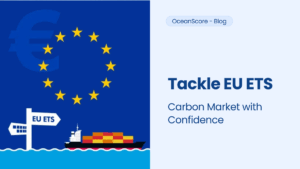
Tackle EU ETS Carbon Market with Confidence

As 2024 draws to a close, it marks a pivotal year for the EU ETS Carbon Market, especially with the…

OceanScore
3 min read

UK ETS Maritime: Preparing for a Confirmed 1 July 2026 Start

The UK ETS Maritime framework is set to begin on 1 July 2026, introducing a new layer of carbon-pricing obligations…

OceanScore
biofuelsFuelEUfueleu maritime regulationmaritime datashipping companies
5 min read

Decoding alternative fuels: OceanScore supports tricky bunker selection process under FuelEU Maritime

OceanScore’s FuelEU Planner helps shipping companies navigate fuel selection, compliance costs, and market dynamics to meet FuelEU Maritime regulations with…

OceanScore
Shipping industry professionals discussing EUA procurement strategies and emissions cost management.

carbon dioxide equivalentEmissionsemissions trading system eueu emissionseu emissions trading systemEU ETSEUAsEuropean Union emissions tradingsecondary market
3 min read

Determining a trading strategy for EUAs

EUAs can be purchased at a fixed price at auctions arranged during the year by the European Energy Exchange. They…

OceanScore
EU ETSFuelEUFuelEU pooling marketplace
3 min read

How Shipping Companies Can Turn FuelEU Maritime Compliance Into a €500M Profit Opportunity 

As global trade grows and decarbonization pressures increase, the shipping industry is facing heightened scrutiny over its environmental impact. At…

OceanScore
imomaritime regulationMEPC
2 min read

OceanScore’s commentary on MEPC ES and IMO NZF

The IMO’s Net Zero Framework is effectively dead, and the broader role of the MEPC is now in question. Friday’s…

OceanScore
Stakeholders in the shipping industry discussing EUA cost allocation under EU ETS.
Best Practicescarbon marketEmissionseu carboneu emissionseu emissions trading systemEU ETSEUAsFuelEUfueleu maritime regulation
3 min read

Securing contractual clauses for EUA costs settlement 

Acquisition of EUAs constitutes a major cost burden for the responsible party so these costs need to be fairly allocated…

OceanScore
The EU ETS poses a costs management challenge for shipping companies, according to OceanScore co-Managing Director Albrecht Grell.
emissions trading system euEU ETSeu ets managementfinancial blancingshipping companies
6 min read

Shipping companies must manage financial balancing act on EU ETS tightrope, says OceanScore

Shipping companies face rising costs and risks from the EU Emissions Trading System (EU ETS) in 2026, with higher carbon…

OceanScore
Turn obligation into opportunity

Turn obligation into opportunity

Explore our maritime emissions compliance solutions designed to meet evolving regulations like EU ETS and FuelEU Maritime.

our clients and partners