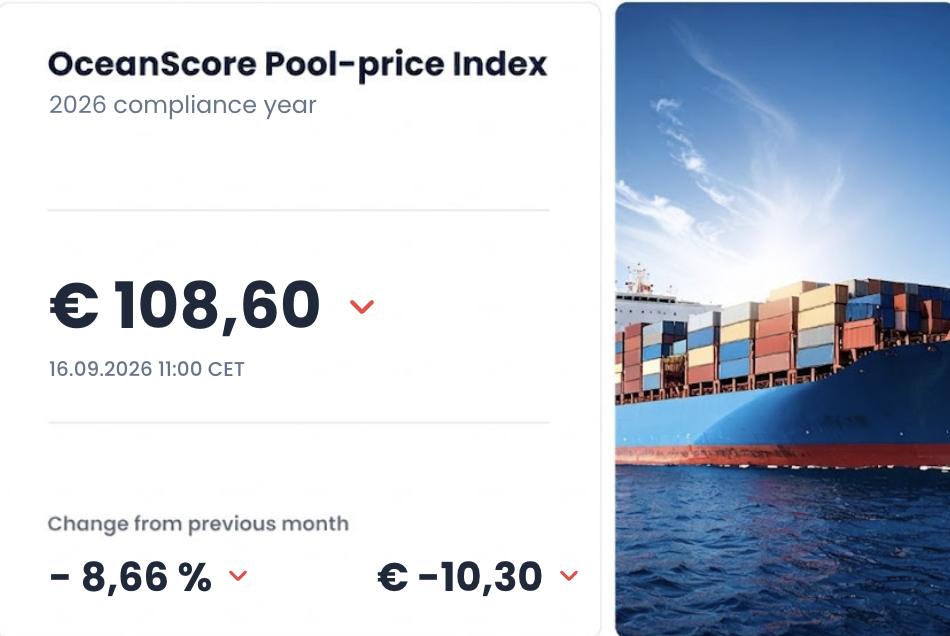
OPX (2026) €171.00 $197,00 -24.0% to prev. month
EUA €68.86 $80.22 -0.86% to prev. day
emissions trading system eueu allowance euaEU ETSeu ets managementRed Sea crises
4 min read

OceanScore analysis shows near-tripling of EU ETS costs due to Red Sea crisis

Houthi missile attacks on Red Sea shipping routes lead to higher emissions and increased costs for shipping companies under the EU ETS as vessels divert to the Cape of Good Hope.

OceanScore
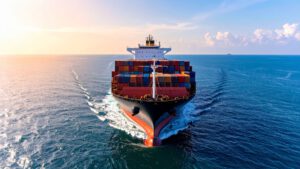
Ships plying the Red Sea route to Europe are running the gauntlet of Houthi missile attacks in the Bab-el-Mandeb strait. Image: Shutterstock

Table of Contents

  1. Higher emissions fuel voyage costs 
  2. Rising EUA requirement for boxships   
  3. Uncertain outlook for ocean freight

Persistent missile attacks by Houthi rebels on ships plying the Red Sea route have led to soaring emissions liabilities for shipping companies under the EU ETS as lengthy voyage diversions for Europe-bound vessels have multiplied fuel consumption, according to OceanScore.


An increasing number of commercial ships have been taking the alternative route to Europe via the Cape of Good Hope – adding around 9000 nautical miles, or 80%, to the distance sailed – to avoid the Houthi threat as over 50 vessels passing through the Bab-el-Mandeb strait have so far been targeted by the Iran-backed militant group despite protective measures by a broad multi-national coalition.


The latest figures from Clarksons Research show that container ship transits via the Gulf of Aden to the Mediterranean have dropped 91% from the first half of December as around 620 vessels have been diverted, while bunker and crude tanker transits are down 37% and 31%, respectively. Conversely, Cape of Good Hope tonnage arrivals have risen 81% since December.

Higher emissions fuel voyage costs 

The consequent disruption to critical trade routes has resulted in spot freight rates increasing by two to three times versus pre-disruption levels while charter rates are up 28% from December, according to Clarksons.


Furthermore, Hamburg-based maritime technology firm OceanScore has calculated the widescale diversion of marine traffic is fuelling the costs of shipping companies due to significantly higher exposure to the EU Emissions Trading System (EU ETS), which imposes liability for 50% of emissions for voyages to and from the EU and 100% for port calls and transits within the bloc.


OceanScore has estimated the route via the Cape has tripled bunker consumption due to the longer distance and an approximate 25% increase in sailing speed from 16 to 20 knots, based on its AIS tracking of mainly container vessels.


“We have observed increased speeds to compensate for at least some of the longer distance – to keep sailing times and the need for additional tonnage to be deployed at acceptable levels – and this has an inevitable impact on fuel consumption and emissions,” OceanScore’s co-Managing Director Albrecht Grell says.


Rising EUA requirement for boxships   

Modelling analysis conducted by the firm, based on the case of a 14,000-TEU container ship, has shown the number of EU Allowances (EUA), or carbon credits, necessary to cover emissions would rise from 1800 per voyage to 5200 per voyage with the current 40% liability requirement under the three-year phase-in of the EU ETS from 1 January 2024, rising to 70% next year and 100% in 2026.


This would translate into a near-threefold increase in EUA costs from €98,000 to €285,000 per voyage this year, based on the current carbon price of around €55 per tonne of CO2, or a hike of €18 per twenty-foot equivalent unit (TEU), according to OceanScore, which is supporting companies with its web-based ETS Manager application for tracking, accounting and allocation of EUAs.


Grell points out that, if the volatile carbon price returns to the level of around €100 that it reached a year ago, these costs would nearly double. “With complete phase in of the EU ETS to 100% of emissions, we would see another 250% increase that would bring the cost mark-up per box to around €80,” he says.

“It goes without saying that changes in sailing speeds, different vessel sizes, utilizations and the overall energy efficiency of the vessel used will all have a significant impact on the above analysis – but the general trend will be the same,” Grell adds.


Uncertain outlook for ocean freight

While €80 per box “sounds like a lot of money”, he underlines that EUA liabilities are still not the major cost driver for current high freight rates that reflect increased bunker expenses and tonne-miles sailed with the Cape route.


“The threat level to Red Sea shipping remains high and it is uncertain how long this situation will persist for ocean freight given the Houthi attacks continue unabated. Shipping companies must therefore prepare and take account of higher emissions liabilities for the foreseeable future,” Grell says. 


“Ultimately, however, the issue of EUA and other costs is secondary to ensuring the safety of crews and ships, which of course is the primary consideration and must remain paramount.”


For more information contact:

Candice Buckle, Marketing Manager, OceanScore.

Email: candice.buckle@oceanscore.com
 

Related posts

FuelEUfueleu maritime regulationimo
2 min read

IMO MEPC83 – April May Define the Future of Maritime Decarbonization

Discover how MEPC83 affects shipping companies in 2025, from new IMO decarbonization targets to emerging compliance risks and regional rule…

OceanScore
Asian shipping companies confront rising EU ETS costs, with major impacts on compliance and emissions trading.
Asiaemissions trading systemeu emissioneu emissions tradingshipping companiestrading system eu

5 min read

Asian shipowners face hefty emissions liabilities of €1bn for EU-bound voyages

Asian shipowners with vessels sailing to and from Europe are likely to face estimated emissions liabilities of over €1 billion…

OceanScore
4 min read

Maritime Compliance in 2026: What Commercial and Technical Teams Need to Prepare For

2026 will be a decisive year for maritime compliance. As FuelEU Maritime completes its first compliance cycle, EU ETS reaches…

OceanScore
FuelEUpooling
3 min read

Pooling Compliance Balances in Time Charters: Key Risks and Negotiation Tips

With verification according to EU ETS completed for most shipping companies, a critical assessment of EUA buying strategies is a…

OceanScore
EU ETSFuelEUFuelEU pooling marketplace
3 min read

How Shipping Companies Can Turn FuelEU Maritime Compliance Into a €500M Profit Opportunity 

As global trade grows and decarbonization pressures increase, the shipping industry is facing heightened scrutiny over its environmental impact. At…

OceanScore
A large cargo ship loaded with colorful shipping containers is docked at a busy port, with cranes, trucks, and bright blue sky in the background.
Environmental Ship IndexESI
8 min read

Environmental Ship Index (ESI): The Complete Guide for Shipping Companies and Ports

The Environmental Ship Index (ESI) is the world’s leading port incentive scheme, rewarding ships performing beyond emission standards with port…

Damla Hasenclever
Shipping companies face compliance challenges under the EU ETS, requiring carbon credit purchases, data verification, and cost allocation strategies. Learn how to navigate these complexities.
EmissionsEU ETSEUAs
2 min read

Getting up to speed with the EU ETS: a guide to best practice

Implementation of the EU ETS for shipping from 1 January 2024 entails new regulatory complexity and financial risk with significant…

OceanScore
Newsletter banner for OceanScores November 2025 Pool-Price Index Market Commentary, featuring an aerial view of a large container ship moving through the ocean.
FuelEUFuelEU PoolingOPX
1 min read

OceanScore Pool-Price Index Market Commentary: November 2025

With the ability to generate additional surplus limited by the approaching year-end, and demand picking up, prices for pooling edged…

Albrecht Grell
Three representatives posing with signed documents in front of a ClassNK backdrop during a collaboration announcement with OceanScore
class nkEU ETSFuelEUmaritime datamaritime operationsPartnershipsupply chain
2 min read

ClassNK and OceanScore ink collaboration for data-driven regulatory compliance

A collaboration agreement has been signed between a classification society ClassNK and a maritime data and technology firm OceanScore to…

OceanScore
Ribbon-cutting ceremony marking the opening of OceanScore’s Singapore office, with three representatives standing in front of a display welcoming visitors to the new location.
asian shipping emissionsets managerEU ETSfueleu maritime regulationSingapore
5 min read

OceanScore opens new Singapore office for Asia Pacific expansion amid rising demand for compliance solutions

OceanScore opens a new office in Singapore to support rising demand for its digital solutions, helping shipping companies comply with…

OceanScore
Turn obligation into opportunity

Turn obligation into opportunity

Explore our maritime emissions compliance solutions designed to meet evolving regulations like EU ETS and FuelEU Maritime.

our clients and partners