EmissionsEU ETSEUAs
2 min read

Getting up to speed with the EU ETS: a guide to best practice

Implementation of the EU ETS for shipping from 1 January 2024 entails new regulatory complexity and financial risk with significant liabilities for the industry due to the requirement for shipping companies to purchase carbon credits to compensate for their annual emissions.    This presents a new set of challenges for shipping companies such as determining […]

OceanScore
Shipping companies face compliance challenges under the EU ETS, requiring carbon credit purchases, data verification, and cost allocation strategies. Learn how to navigate these complexities.

Implementation of the EU ETS for shipping from 1 January 2024 entails new regulatory complexity and financial risk with significant liabilities for the industry due to the requirement for shipping companies to purchase carbon credits to compensate for their annual emissions. 


This presents a new set of challenges for shipping companies such as determining who is responsible for compliance with the EU ETS, who should pay for emissions, what contractual obligations need to be in place, data-handling and verification procedures, how to procure carbon credits, what trading platform to use and how to allocate costs across the value chain. 


In order to navigate these myriad complexities, administrative systems need to be set up with digital automation of the various processes to effectively manage and mitigate the risks and ensure efficient compliance with the regulation, given non-compliance can incur heavy financial penalties or even an EU trading ban for an entire fleet. 


OceanScore has been supporting dozens of partners in efficiently managing compliance with this regulation and securing end-to-end transparency to limit the inherent risks. In this series of blogs, we share some of our insights for EU ETS best practice to clarify the steps required.  

While not definitive, as the diverse nature of shipping requires a tailored approach, it is intended as a useful guide to help companies define their EU ETS strategy and avoid some of the pitfalls on the difficult path to compliance. 
Related posts

carbon pricecost effectiveemission reductionsemissions trading system eueu emissions trading systemeuropean unionshipping companies
1 min read

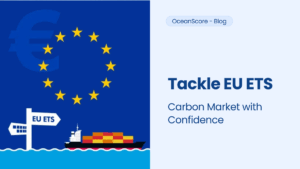
Tackle EU ETS Carbon Market with Confidence

As 2024 draws to a close, it marks a pivotal year for the EU ETS Carbon Market, especially with the…

OceanScore
cap and trade systemcarbon energy demonstration projectsetsets managereu emissions trading systemEU ETSeuropean unionshipping companies
4 min read

Managing data and finding the right digital solution

The EU ETS necessitates that shipping companies implement a reliable EU ETS data management solution to handle complex administrative processes…

OceanScore
cap and trade systemco2 emissionseu emissions trading systemincluded in the eushipping companiesverified emissions
5 min read

One Year of EU ETS – What Have We Learned, What Lies Ahead?

EUAs can be purchased at a fixed price at auctions arranged during the year by the European Energy Exchange. They…

OceanScore
Shipping industry professionals discussing EUA procurement strategies and emissions cost management.

carbon dioxide equivalentEmissionsemissions trading system eueu emissionseu emissions trading systemEU ETSEUAsEuropean Union emissions tradingsecondary market
3 min read

EUA Trading Strategy for Shipping: How to Buy EU Allowances Efficiently

EUAs can be purchased at a fixed price at auctions arranged during the year by the European Energy Exchange. They…

OceanScore
European Union emissions tradingFuelEUmaritime datamaritime operationsmodel pricepenaltiespooling
6 min read

OceanScore models price scenario for FuelEU pooling as alternative to penalties

OceanScore provides insights on compliance surpluses and price clarity for FuelEU Maritime's pooling mechanism, offering shipping companies cost-effective compliance solutions.

OceanScore
3 min read

EU ETS and FuelEU Compliance: The Hidden Risk of Manual Invoicing

Manual invoicing under EU ETS and FuelEU Maritime can quietly block cost recovery. See how one Greek owner-manager safeguarded €2–3…

OceanScore
Shipping companies managing EU ETS carbon credit trading and compliance risks.
emissions trading system eueu allowance euaeu carbonEU ETSeu ets management
7 min read

Trading places: shipping must manage new financial risks with transition to EU ETS, says OceanScore

A collaboration agreement has been signed between a classification society ClassNK and a maritime data and technology firm OceanScore to…

OceanScore
imomaritime regulationMEPC
2 min read

OceanScore’s commentary on MEPC ES and IMO NZF

The IMO’s Net Zero Framework is effectively dead, and the broader role of the MEPC is now in question. Friday’s…

OceanScore
Greek shipowners face EU ETS costs, stressing data and contract management.
EU ETSeu ets managementgreek shippingmaritime datamaritime operationssupply chain
4 min read

Greek shipping getting to grips with EU ETS compliance issues amid mounting emissions costs, says OceanScore

Greek shipowners are facing an estimated €335m bill under the EU Emissions Trading System (EU ETS) in 2024, potentially rising…

OceanScore
EU ETSFuelEUFuelEU pooling marketplace
3 min read

How Shipping Companies Can Turn FuelEU Maritime Compliance Into a €500M Profit Opportunity 

As global trade grows and decarbonization pressures increase, the shipping industry is facing heightened scrutiny over its environmental impact. At…

OceanScore
Turn obligation into opportunity

Turn obligation into opportunity

Explore our maritime emissions compliance solutions designed to meet evolving regulations like EU ETS and FuelEU Maritime.

our clients and partners