Ports play a critical role in global trade, but they are also increasingly expected to understand and manage the environmental impact of vessel traffic. Emissions from ships calling at ports contribute to greenhouse gas emissions as well as local air pollution affecting surrounding communities. Governments, regulators, and local stakeholders are placing greater emphasis on transparency around emissions and the effectiveness of environmental initiatives. As a result, port emissions monitoring is becoming an essential tool for ports seeking to improve air quality and reduce greenhouse gas emissions.
However, measuring emissions from ships in port environments is not straightforward. Vessel movements are complex, ship types vary widely, and reliable data has historically been difficult to access. Reliable port emissions monitoring allows ports to identify emission sources, track progress over time, and evaluate environmental initiatives.
This guide explains how vessel emissions occur in ports, why measuring them can be challenging, and how ports can use emissions data to support clean air strategies and decarbonization initiatives.
What Are Vessel Emissions in Ports?
Ships produce several types of emissions while operating in and around ports. These emissions result primarily from the combustion of marine fuels in ship engines and auxiliary systems.
The main pollutants generated by vessels include:
Carbon dioxide (CO₂)
A greenhouse gas contributing to climate change.
Nitrogen oxides (NOx)
Air pollutants that contribute to smog formation and respiratory problems.
Sulphur oxides (SOx)
Produced when fuel containing sulphur is burned, contributing to acid rain and air pollution.
Particulate matter (PM)
Fine particles that affect air quality and human health.
Methane (CH₄) and nitrous oxide (N₂O)
Additional greenhouse gases that contribute to the overall climate impact of shipping.
These emissions occur throughout different phases of vessel activity in port areas, including when ships approach the port, manoeuvre within port waters, wait at anchorage, and remain at berth.
Understanding when and where these emissions occur is essential for ports seeking to manage their environmental impact.
Where Vessel Emissions Occur in Ports
Vessel emissions in port environments are generated during several operational stages.
Port approach and transit
Ships approaching a port operate their main engines at reduced speed but still generate emissions.
Manoeuvring in port waters
During docking and undocking, vessels use main engines and thrusters, which can increase emissions for short periods.
At berth
While docked, ships typically run auxiliary engines to generate electricity for onboard systems such as lighting, ventilation, refrigeration, and cargo operations.
Anchorage areas
Ships waiting for berth availability often remain at anchor with auxiliary engines running.
Each of these phases contributes to the total emissions associated with vessel activity in a port. For ports aiming to reduce emissions or improve air quality, it is important to understand how emissions are distributed across these operational phases.
Why Port Emissions Monitoring Is Difficult
Despite growing interest in monitoring emissions, many ports struggle to obtain reliable emissions data. Several factors contribute to this challenge.
Complex vessel activity
Ships operate differently depending on cargo type, size, engine configuration, and operational practices.
Limited standardized data
Ports may receive limited information about vessel fuel use, engine power, or operational patterns.
Different emission sources
Ships generate emissions from both main propulsion engines and auxiliary engines.
Variability between vessels
Two vessels of the same size may have very different emissions depending on engine technology and fuel type.
Because of these factors, ports often rely on high-level estimates or generic assumptions rather than detailed emissions insights. This makes it difficult to accurately assess the environmental impact of vessel traffic.
How Vessel Emissions Can Be Measured
Advances in maritime data and analytics now make it possible to estimate vessel emissions more accurately.
One of the key technologies enabling this is Automatic Identification System (AIS) data, which tracks the position, speed, and movements of ships worldwide.
By combining AIS data with vessel technical specifications such as engine power and fuel consumption profiles, emissions models can estimate how much fuel vessels consume during different operational phases.
From this information, emissions of pollutants such as CO₂, NOx, SOx, and particulate matter can be calculated.
The general process involves:
- Tracking vessel movements using AIS data
- Identifying vessel characteristics such as engine power and ship type
- Estimating engine load during different operational phases
- Applying emission factors to calculate pollutant output
This activity-based approach enables ports to obtain a much more detailed understanding of emissions generated within their port areas.
The Role of Ports in Reducing Vessel Emissions
While ships themselves are operated by shipping companies, ports still play an important role in influencing emissions.
Ports can contribute to emissions reduction through several measures.
Infrastructure investments
Providing shore power infrastructure allows vessels to switch off auxiliary engines while at berth.
Environmental incentive schemes
Many ports offer discounts or incentives to ships that meet higher environmental performance standards.
Operational improvements
Better berth planning and traffic management can reduce waiting times and unnecessary manoeuvring.
Data transparency
Providing reliable emissions data helps ports evaluate the effectiveness of their environmental initiatives.
By understanding emissions generated by vessel traffic, ports can make more informed decisions about environmental investments and policies.
Environmental Incentive Schemes for Ships
Many ports have introduced environmental incentive programs to encourage cleaner shipping.
These programs typically reward ships with lower emissions through reduced port fees or other incentives.
Some of the most widely used schemes include:
Environmental Ship Index (ESI)
An international program developed by the International Association of Ports and Harbors (IAPH) that scores vessels based on emissions performance.
Clean Shipping Index (CSI)
A voluntary system that evaluates ships based on environmental criteria including emissions and chemicals.
Environmental Port Index (EPI)
A framework used by some ports to assess environmental performance during port calls.
Such schemes help ports encourage cleaner ships to call at their facilities. However, to evaluate their effectiveness, ports need reliable emissions data showing whether these programs actually lead to measurable environmental improvements.
Measuring the Impact of Clean Air Initiatives
Ports are increasingly investing in measures designed to reduce emissions and improve air quality.
These may include:
- shore power infrastructure
- environmental incentive schemes
- support for alternative fuels
- operational efficiency improvements
To justify these investments, ports need to be able to measure their impact over time.
Questions ports often ask include:
- Which vessels contribute most to emissions in the port?
- How have emissions changed over time?
- Are incentive programs attracting cleaner vessels?
- Which port areas generate the highest emissions?
Without consistent emissions monitoring, it can be difficult to answer these questions.
What Ports Need to Monitor Emissions Effectively
For ports to understand vessel emissions in their port areas, several elements are required.
Reliable vessel activity data
Tracking ship movements and operational patterns.
Vessel-specific information
Understanding engine types, fuel consumption characteristics, and ship categories.
Consistent emissions modelling
Applying standardized methods to estimate emissions across vessel types and operational phases.
Time-based analysis
Monitoring emissions trends over time to evaluate the impact of initiatives.
When these elements are combined, ports can gain a much clearer picture of emissions generated by vessel traffic.
How PortView Helps Ports Understand Emissions
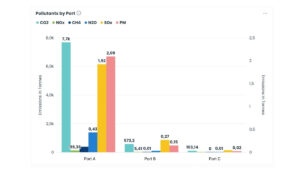
PortView enables port emissions monitoring across all vessel activities within port areas, providing ports with detailed insights into emissions by vessel, ship type, pollutant, and time period.
Using vessel movement data and emissions modelling, the platform enables ports to analyze emissions across multiple dimensions.
Ports can explore emissions data based on:
- time period
- individual vessel
- ship type
- port area or terminal
- pollutant type
PortView provides emissions estimates for pollutants including CO₂, NOx, SOx, particulate matter (PM), methane (CH₄), and nitrous oxide (N₂O).
This allows ports to identify emission hotspots, understand which vessels contribute most to emissions, and evaluate the impact of environmental initiatives such as shore power or incentive schemes.
By turning complex vessel activity into actionable emissions insights, PortView helps ports support their clean air strategies and communicate progress to stakeholders.
Try PortView Free for 14 Days
To help ports explore the value of emissions insights directly, OceanScore offers a 14-day free trial of PortView.
During the trial, ports can:
- explore emissions insights for their port
- identify emission hotspots
- analyze emissions by vessel and ship type
- understand trends over time
Reliable port emissions monitoring helps ports understand where emissions originate, identify the vessels contributing most to emissions, and evaluate the effectiveness of clean air initiatives. This allows ports to see how emissions monitoring can support environmental strategy and decision-making.
Start your free 14-day PortView trial and explore emissions insights for your port today.