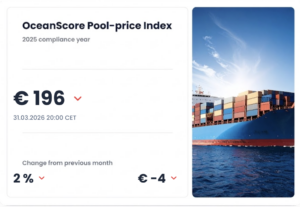
OPX (2025) €196.00 $227.45 -6% to prev. month
EUA €68.86 $80.22 -0.86% to prev. day
FuelEU Pooling
3 min read

FuelEU Pooling Deadline April 2026: What It Means for Shipping Companies

FuelEU pooling decisions must be finalised by April 30, 2026. This article explains what this means for shipping companies and why execution, timing and market data matter.

Damla Hasenclever

Table of Contents

  1. From Reporting to Execution: The First Real FuelEU Test
  2. What Has Happened So Far
  3. What Needs to Happen in April
  4. Beyond Regulation: The Operational Reality
  5. Pooling: The Most Complex Option
  6. Market Dynamics: Why Timing and Data Matter
  7. From Visibility to Execution
  8. What This Means for Shipping Companies
  9. Conclusion

From Reporting to Execution: The First Real FuelEU Test

The first FuelEU compliance cycle is now moving from reporting into execution. Following submission and verification of 2025 FuelEU reports, shipping companies now face a critical decision: how to manage each vessel’s compliance balance before the April 30, 2026 pooling deadline. While the regulation defines the available mechanisms, the challenge lies in how these are applied in practice.

What Has Happened So Far

The initial steps of the FuelEU compliance cycle are now complete:

  • By January 31, 2026: FuelEU reports were submitted
  • By March 31, 2026: Reports were verified and recorded

At this stage, each vessel has a defined compliance balance: either a surplus or a deficit.

What Needs to Happen in April

During April, companies must decide how to manage these compliance balances. For each vessel, one of three mechanisms must be selected and recorded:

  • Banking: carrying surplus into the next compliance period
  • Borrowing: using limited future surplus to cover a deficit
  • Pooling: balancing deficits through surplus from other vessels

These decisions must be finalised and recorded in the FuelEU database by April 30, 2026.

Beyond Regulation: The Operational Reality

While the regulatory framework is clearly defined, execution is not straightforward. In practice, companies are facing several challenges:

  • Identifying available surplus
  • Finding suitable counterparties for pooling
  • Assessing pricing and timing
  • Aligning decisions across chartering, operations and finance

As a result, FuelEU compliance is no longer a reporting exercise. It has become an operational and commercial process.

Pooling: The Most Complex Option

Among the available mechanisms, pooling introduces the highest level of complexity. It requires:

  • Access to surplus from other participants
  • Agreement on pricing and allocation
  • Coordination between multiple counterparties
  • Validation and recording within tight deadlines

At the same time, market conditions are evolving rapidly.

Market Dynamics: Why Timing and Data Matter

As we’ve mentioned in our latest OPX commentary, the recent developments indicate that the FuelEU pooling market is currently characterised by surplus oversupply.

This has several implications:

  • Increased availability of surplus in the market
  • Downward pressure on prices
  • Growing importance of timing decisions

In this environment, access to structured market data becomes critical. Understanding pricing dynamics, available volumes and counterparties is no longer optional. It directly impacts compliance cost outcomes.

From Visibility to Execution

The first FuelEU cycle highlights a key shift: Visibility alone is not sufficient. Execution determines the outcome. Companies that:

  • rely only on internal calculations
  • delay decisions
  • or lack access to counterparties

may face higher costs or limited options as deadlines approach.

What This Means for Shipping Companies

The April deadline is more than a regulatory milestone. It represents the first real test of how FuelEU compliance is managed in practice. Not just calculated, but executed.

Companies that establish structured processes, access market data and engage early in pooling discussions will be better positioned to manage compliance exposure and avoid unnecessary costs.

Conclusion

FuelEU introduces a new layer of complexity to maritime operations but also a new layer of commercial decision-making. As the market continues to develop, the ability to combine regulatory understanding with market insight and execution capability will define successful compliance strategies.


Access current pooling opportunities, OPX insights and market commentary through OceanScore’s FuelEU Pooling Marketplace. Contact us to get an access.

Related posts

FuelEU pooling marketplace
5 min read

Maritime Compliance Trading: Turning Emissions Rules into Carbon Opportunities and Marketplaces

The Regulatory Landscape: Fast, Complex, and Overlapping   Regulation in maritime decarbonisation continues at unrelenting speed, and with it, the…

OceanScore
Aerial view of a cargo ship’s deck and equipment traveling across the ocean, used as a blog image for FuelEU pooling price scenario analysis
European Union emissions tradingFuelEUmaritime datamaritime operationsmodel pricepenaltiespooling
6 min read

OceanScore models price scenario for FuelEU pooling as alternative to penalties

OceanScore provides insights on compliance surpluses and price clarity for FuelEU Maritime's pooling mechanism, offering shipping companies cost-effective compliance solutions.

OceanScore
FuelEUpooling
3 min read

Pooling Compliance Balances in Time Charters: Key Risks and Negotiation Tips

With verification according to EU ETS completed for most shipping companies, a critical assessment of EUA buying strategies is a…

OceanScore
EU ETSFuelEUFuelEU pooling marketplace
3 min read

How Shipping Companies Can Turn FuelEU Maritime Compliance Into a €500M Profit Opportunity 

As global trade grows and decarbonization pressures increase, the shipping industry is facing heightened scrutiny over its environmental impact. At…

OceanScore
FuelEUFuelEU Pooling
3 min read

FuelEU Pooling in 2026: From Commercial Agreement to Verified Compliance Process

FuelEU pooling in 2026 is no longer just a commercial agreement. Surplus transfers must be formally reported, approved by all…

Damla Hasenclever
Aerial view of a large container ship loaded with multicolored cargo containers traveling across open water, used as a blog image for FuelEU Maritime pooling discussion
eu regulationsFuelEUfueleu maritime regulationfueleu plannermaritime data
8 min read

The price of pooling: OceanScore takes market-based approach to FuelEU Maritime

FuelEU Maritime introduces new shipping regulations, offering compliance pooling benefits. OceanScore analyzes surplus pricing and market dynamics.

OceanScore
EU ETSFuelEUFuelEU pooling marketplace
4 min read

Navigating EU Maritime Regulations: A Different Challenge for Commercial Pools, Operators and Charterers

As global trade grows and decarbonization pressures increase, the shipping industry is facing heightened scrutiny over its environmental impact. At…

OceanScore
FuelEUpooling
4 min read

FuelEU Maritime Pooling: A Viable Strategy

FuelEU allows for pooling compliance deficits and surpluses as one way to secure compliance. OceanScore analyses continues to show that…

OceanScore
FuelEUFuelEU Pooling
5 min read

FuelEU Maritime Compliance: Why Pooling Is Infinitely Better Than Paying the Penalty

As global trade grows and decarbonization pressures increase, the shipping industry is facing heightened scrutiny over its environmental impact. At…

OceanScore
FuelEUFuelEU Pooling
2 min read

FuelEU Maritime Charterer Pooling: Will Your Charterer Pool?

As the first FuelEU Maritime compliance year comes to a close, the reality of pooling is taking shape. Based on…

OceanScore
Turn obligation into opportunity

Turn obligation into opportunity

Explore our maritime emissions compliance solutions designed to meet evolving regulations like EU ETS and FuelEU Maritime.

our clients and partners