FuelEU Maritime compliance does not begin at verification. It develops continuously throughout the year.
While vessel operations are driven by cargo requirements and commercial commitments, FuelEU Maritime introduces an exposure that accumulates over time. Small operational differences, such as trading patterns within EU waters or fuel choices can materially affect a vessel’s annual compliance position, even when all deployments are operationally viable. Understanding these effects early is critical to managing cost and risk.
FuelEU Exposure Builds Gradually. Costs Do Not
FuelEU Maritime compliance is assessed on a full-year basis, but exposure forms voyage by voyage. A single change in trading pattern within EU waters, an additional EU port call, or a shift in fuel type can alter the annual compliance balance. These changes often remain invisible until verification, when flexibility is limited and costs are fixed.
If deficits cannot be covered at that stage, penalties apply. Under FuelEU Maritime, penalty levels can rise quickly, making late visibility commercially risky. The challenge is not regulatory complexity. It is the lack of timely insight.
Forecasting Under Real Operational Constraints
FuelEU Maritime does not determine how vessels trade. Port rotations and deployments are driven by cargo, not regulation. The practical challenge for shipowners and managers is therefore to understand how different operationally viable deployment options affect overall FuelEU compliance exposure, and to prepare for these outcomes in advance.
In one recent case, a shipping company used compliance forecasting to compare two alternative deployments for a vessel trading in European waters. Both options were operationally sound. The open question was how each scenario would affect the vessel’s full-year FuelEU compliance position and what level of compliance action would be required under either outcome.
Forecasting provided early clarity on the range of possible exposure outcomes, allowing the company to plan ahead rather than react once exposure was fixed.
From Reporting to Active Compliance Management
Traditional compliance workflows focus on reporting historical data. FuelEU Maritime requires a shift toward active exposure management.
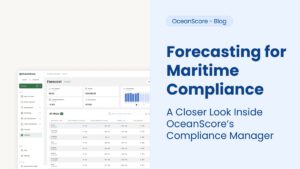
OceanScore’s Compliance Forecaster provides a continuously updated, data-based view of expected EU ETS and FuelEU exposure for each vessel and fleet. Instead of static reporting, it allows users to assess how operational scenarios translate into compliance outcomes before decisions are finalised. The module enables users to:
Simulate time- or voyage-based scenarios using actual vessel data
Adjust assumptions for fuel type, consumption, or deployment
Compare expected compliance outcomes across different operational options
This allows shipping companies to evaluate compliance implications before execution, rather than managing them after the fact.
Forecasting Supports Preparedness, Not Execution
Forecasting does not execute compliance. It does not settle balances or replace operational decision-making. What it does is provide the clarity for:
Understanding likely compliance exposure early in the year
Preparing appropriate compliance strategies in advance
Reducing reliance on last-minute decisions and penalty-level outcomes
Used within a structured compliance process, forecasting becomes a practical commercial tool, supporting decisions on timing, risk, and cost before verification removes flexibility.
Conclusion
FuelEU Maritime compliance does not change how vessels are deployed. But it does change the financial consequences of those deployments.
Forecasting provides a structured way to understand how real operational scenarios affect annual compliance exposure early enough to keep options open. It does not predict the future. It prepares companies for it.
Contact OceanScore now to find more about Compliance Forecaster.