EU ETS and FuelEU Maritime have significantly expanded the scope and complexity of emissions compliance in shipping. For many companies, the challenge is no longer understanding the regulation, but executing the associated commercial processes reliably and at scale.
One large Greek owner-manager experienced this first-hand.
Despite being active under both EU ETS and FuelEU Maritime, the company did not scale its compliance organisation in line with the growing operational requirements. As a result, a material EU ETS invoicing risk emerged. Not due to lack of regulation awareness, but due to capacity constraints and manual workflows.
When Compliance Workload Exceeds Team Capacity
Data quality had not yet reached the standard required for EU ETS and FuelEU Maritime. As a result, the compliance team spent most of its time cleansing and correcting emissions data.
This left no capacity for one critical task: issuing statements and invoices to charterers.
The commercial team, which would normally handle invoicing, chose not to step in. The reasoning was familiar: avoiding friction with charterers and prioritising core commercial activities.
The outcome was predictable.
Of a total €4.5 million in invoicable EU ETS and FuelEU volume, less than half was actually invoiced. Typically only when charterers explicitly requested it.
Manual Invoicing Creates Structural Revenue Leakage
The issue was not a lack of entitlement to recover costs. It was the absence of a structured process that ensured invoices were:
generated systematically
corrected when data changed
sent on time
tracked until collection
Manual workflows made invoicing optional rather than embedded. Responsibility was unclear, monitoring was missing, and commercial exposure grew quietly in the background. This is where EU ETS invoicing risk becomes tangible: compliance costs exist on paper, but cash recovery depends on execution.
Restoring Control with Structured Compliance Workflows
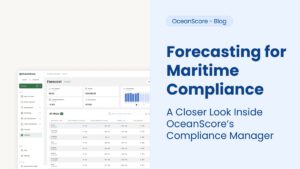
OceanScore’s Compliance Manager addressed two core problems simultaneously.
First, invoices and statements were generated automatically, based on available data. Where data quality issues were later resolved, correction invoices were issued without restarting the process.
Second, a standardised workflow defined clear roles and responsibilities across compliance and commercial teams. Operational monitoring ensured that:
no data point remained unaddressed
no invoice stayed ungenerated
no statement went unsent
no open position went unnoticed
Invoicing became part of the compliance process, not a discretionary task.
Commercial Impact
By stabilising invoicing workflows and eliminating manual gaps, the company protected an estimated: €2–3 million per year in EU ETS and FuelEU cost recovery. Not through regulatory optimisation, but through execution discipline.
The Broader Lesson for Shipping Companies
EU ETS and FuelEU Maritime introduce ongoing, repeatable commercial obligations. When these are handled manually, compliance workload quickly competes with day-to-day operations, and revenue recovery suffers.
The lesson is straightforward: Compliance is not only a regulatory task. It is a commercial process.
Without structured workflows, EU ETS invoicing risk becomes embedded in daily operations, often unnoticed until year-end.
Reducing EU ETS Invoicing Risk Through Structure
Shipping companies facing increasing compliance workload do not necessarily need larger teams. They need processes that:
automate routine execution
clearly assign responsibility
monitor every step from data to invoice to collection
Structured systems replace ad-hoc decisions with predictable outcomes. That is how compliance moves from administrative burden to commercial success. Contact OceanScore today to book a free demo.